
Beach volleyball
A summer classic on the sand that combines movement, fun, and a sporting challenge.
About sport
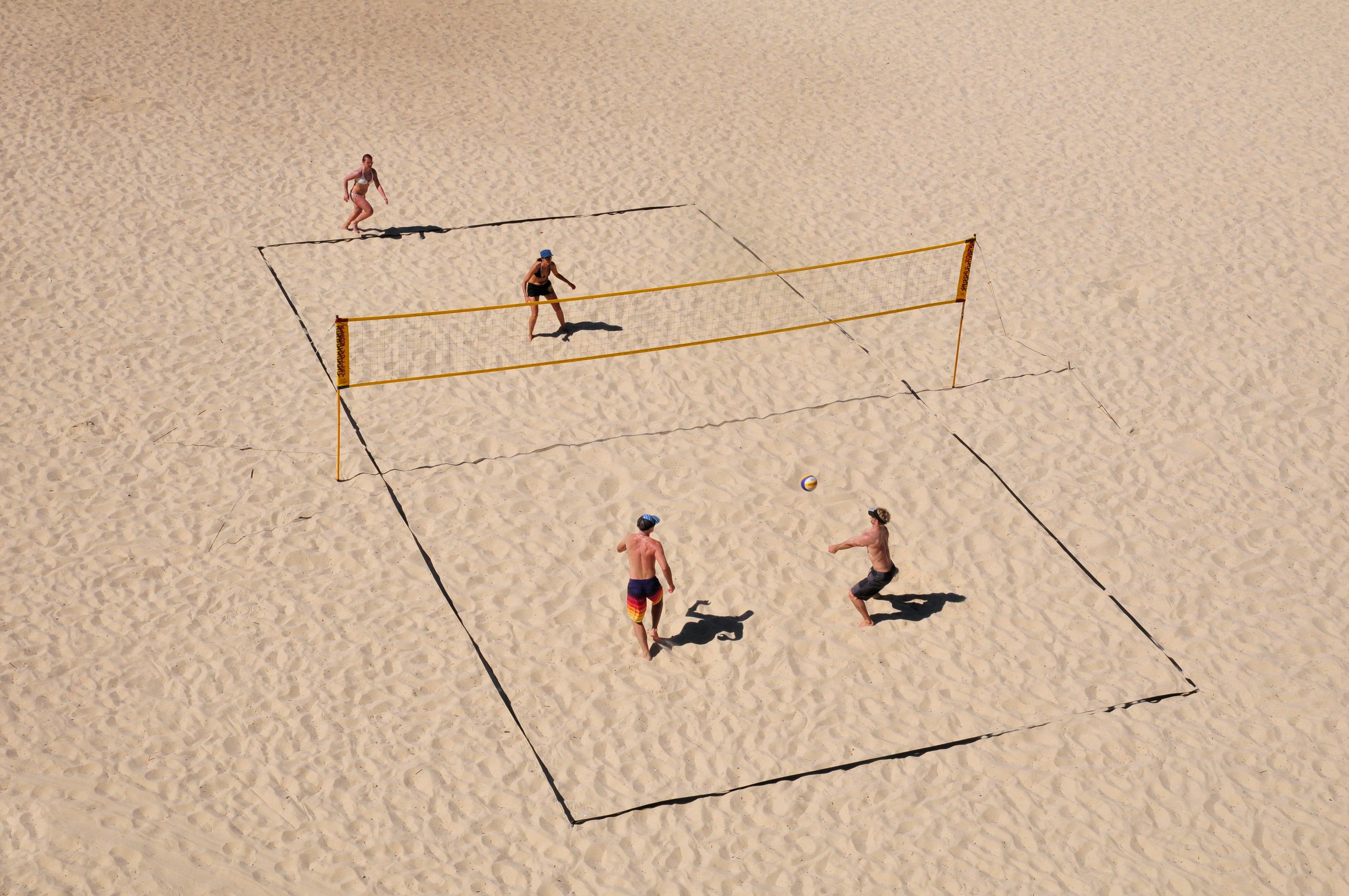
Beach volleyball is an attractive team sport played on sand, which originated as a recreational variation of classic volleyball. Over time, however, it developed into a full-fledged sport with its own rules and international competitions. Thanks to the combination of movement, sunshine, and a relaxed atmosphere, it has gained popularity all over the world.
It is played in pairs on a sand court, which places high demands on the players' physical fitness, endurance, and versatility. Sand slows movement, but at the same time increases the difficulty of the game and engages the whole body. Beach volleyball is an ideal combination of athletic performance and summer fun.
How to Play Beach Volleyball
Rules
The team consists of two players.
The match is played as best of three sets to 21 points. At 1:1, a third set to 15 points is played. In each set, it is necessary to win by at least two points; there is no upper points limit.
Before the start of each match, a draw is held (e.g., rock, paper, scissors). The winner of the draw chooses either the side of the court or whether to serve or receive. In the second set, the second team has the right to choose. Before a possible third set, there is a new draw.
Players play barefoot.
Each team may make up to three hits during a rally, with the block counting as one of them. After a block, the same player may play again.
On serve, players alternate regularly, and each player has only 1 attempt. When serving, the player must not step over the end line. The ball may touch the net on the serve. A toss and subsequent drop of the ball without hitting also counts as an attempt to serve. A serve may not be blocked.
The server's partner must not obstruct the view of the receiving players. If their position blocks the view, the receiving player may ask the obstructing player to change position. The obstructing player is obliged to clear the view.
Receiving a serve with the fingers must be technically clean.
The attacking hit must be played with extended or bent fingers (cobra) or with the palm. Soft tips (gentle, deceptive play with the fingers) are not allowed.
An attack played with the fingers may be sent into the opponent's court only in a direction perpendicular to the axis of the attacking player's shoulders. An unintentional deviation (e.g., by wind) is not considered a fault.
Hard attacks may also be handled by the defense in an “unclean” way (lifting, double contact, finger bump, etc.). If the attack touches the net or a block, the following hit must be clean. For soft attacks (e.g., a lob), a clean reception is always required.
Crossing under the net is allowed, provided that the player does not restrict the opponent's play.
When the ball lands near the sideline or end line, whether the ball is in or out is decided by whether it touches the line. If the line is displaced during play, the line is first straightened and only then is it determined from the ball mark whether it is a good ball or out.
Slight carrying of the ball during the set is allowed
Pushing the ball over the net is allowed. The team on whose side the ball remains in play has the right to the next three touches. If such a ball goes out, it is a fault of the team on the other side.
If both opponents commit two or more faults simultaneously (e.g., touching the net), it is a double fault and the rally is replayed.
The serve is performed with one hand. The receive, set, and attack must be technically clean, but may be performed with any part of the body (it must not be a double contact or a carried ball).
Touching the net with hair is not considered a fault.
Net height:
men and juniors - 2.43 m,
women and junior women – 2.24 m,
14-16 years – 2.24 m,
12–14 years - 2.12 m,
up to 12 years – 2.00 m.